
 Spring means it’s time to plant things. Fix up the yard. Finally put something in that empty pot in the front yard.
I'm an amateur gardener at this point in my life. I have a small space in the yard with a few veggies sprouting up. There's an arch entryway with morning star jasmine trailing up the side. While I still plant things that don't survive and put things in the wrong place in my yard, for the most part I'm finally successful at keeping more things alive than not. But, I had to start somewhere. Years ago, when I planted my first real plant, my grandmother was the first one I called for advice. She's a green thumb if there ever was one and an expert when it comes to spring gardening. You'll never guess what she told me…
0 Comments
 We have really made this word “calling” a complicated, mystical thing. Like it’s reserved for only those who are preachers. Or Bible teachers. Maybe even it’s for the rich and famous. Like Justin Beiber was probably “called” to sing right? Or that boss in that really fancy company was definitely called to that business. Or that homesteading, homeschooling mom of six we follow on social media was for sure called to be a mother.
But “calling” is actually quite simple. If you’ve been overwhelmed by the question, “What am I called to do?” Let’s change that. Let’s walk away today as women on mission, confident in our calling in Christ.  You’re FREE ebook is at the end of this blog!
We’ve all heard the phrase “New year, New Me” about one thousand times. But here’s the deal, we don’t really need a new “us.” Why? Because we start things and don’t finish them. We make New Year’s resolutions and forget what they are by February. When the pressure is on us to fix us, we’re fail every time, right? What we’ve been doing isn’t working! That’s why we don’t need a “new me,” we need a new strategy. Here’s what I’ve been doing each new year and I’m tossing this plan in the trash. I’ve been adding things onto my life thinking these new additions will make my life more fulfilling, that I’ll even experience greater growth in my walk with Christ. More healthy food and exercise… More quiet time with God… Achieve more goals… Make more money… More date nights with my husband… Be more intentional with my kids… Gosh, just thinking of “more” makes my chest start to tighten. Is it doing that to you too? Because I know I need “more” of these things but life already feels full to the brim. If I throw on “more” I’m going to explode. I can’t handle more. I need less. And that is exactly how do we do more of what we know God is calling us into next year….  “Hey! How are you?”
It was the generic question that we all throw out to passersby. However, my friend offered back a response that stopped me in my tracks. “Honestly, not great…” We stood for a moment and chatted. I shared how grateful I was that they gave me an honest answer. They could have said “pretty good” and kept going, heart still heavy. But vulnerability in healthy spaces creates community and invites others in to help us carry the weight. I pray they walked away a little lighter. The reality is that this season isn’t always ribbons and bows, silver and gold, light and lifegiving. Christmas can be hard, dark, and a season of mourning. How many of us are pretending to be “pretty good” when we’re “honestly, not great”? What do we do when our Christmas isn’t exactly merry?  There are more days I wake up already feeling behind the ball than on top of it. It’s as if, no matter how fast I move, time won’t slow down enough to allow me to catch up to it.
You get it. We’re busy women! We have families and kids and jobs and homes and to-do’s and chores and food and then…. we toss in Christmas. A season of light, laughter, families and memories that we’ll so easily rush through if….  This is not the sharing of my two birth stories but rather, a sharing of God’s redeeming grace in and over all things nonetheless. A sharing of hope, of how the Lord brings beauty from ashes and makes all things new in accordance with His perfect plan.
Before divulging too much more, a disclaimer: There will be some details discussed from my two c-sections that could give rise to heavy emotions, thoughts, and feelings if you are in a delicate place processing your own birth, pregnancy, or postpartum experiences. My heart is for yours! God knows every emotion you are encountering. Nothing surprises Him or catches Him off guard. “For by him all things were created, in heaven and on earth, visible and invisible, whether thrones or dominions or rulers or authorities—all things were created through him and for him.” Colossians 1:16 As we come to understand with greater clarity what it looks like to hold grief and joy simultaneously, to live in the “already, but not yet”, we can affirm how that reality permeates different arenas of our every day lives. Our birth stories do not define us. But that doesn’t mean the very means in which the Lord chooses to use in refining us do not matter.  Not might. Not maybe. Jesus promised us that we WILL have suffering. This isn't a popular conversation topic because we want to believe that being a Christian will mean our life is easy. God is on our side so everything will be perfect now. Our prayers are heard so, poof! Amazing things are going to happen for us. Here’s the truth because I think you can handle it...  Here’s the thought I keep having…
What if we're doing what God has made us to do in this season? BUT, what if we're not doing it exactly the way He would want us to do it? I think it's possible that we could be running in just the right lane for us and embracing the place God has us in, all the while not honoring the rest our body, mind and soul need. We're doing the right thing in the wrong way. Instead of overflowing, we're pouring out of an empty cup. So, how do we recover rest? How do we "Sabbath" while we're running full force toward our calling into a busy season? 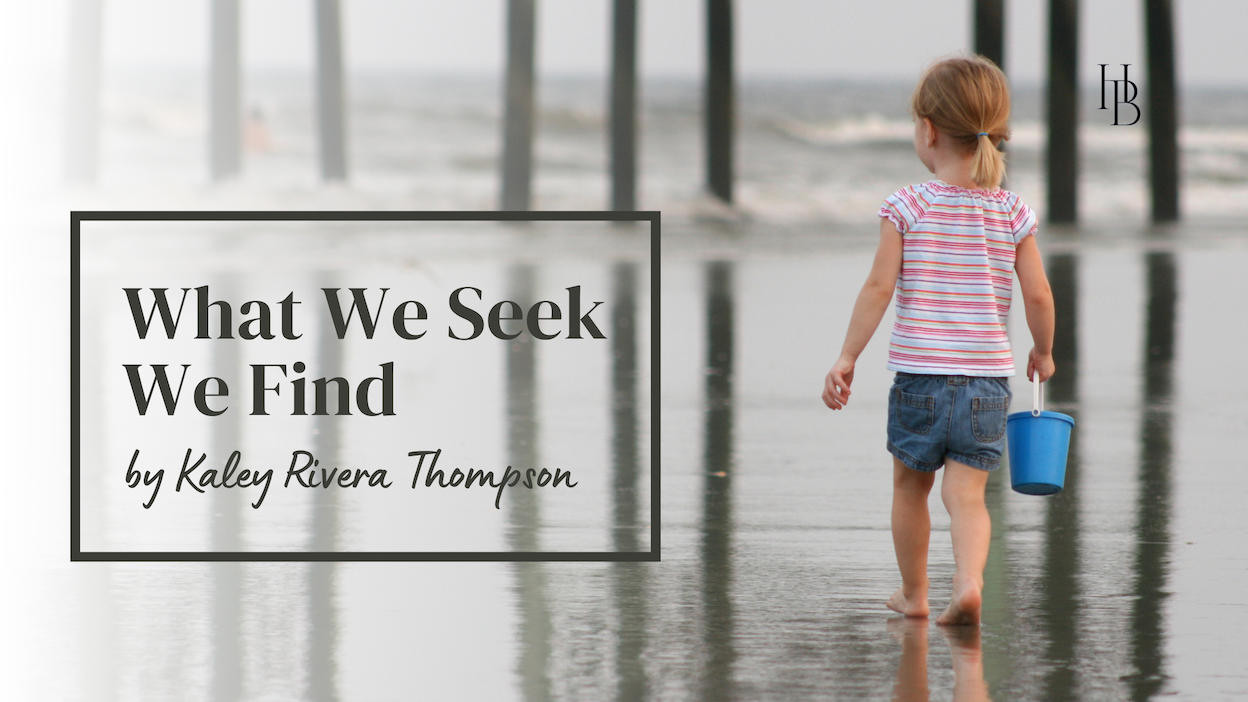 “No way, Mom. I found a shark's tooth!” My six year old’s sun kissed face was beaming as she held up to me with both palms her tiny treasure.
The day before, a kind couple had passed our family on our way off the beach. They were older and looked at our young girls (and us as parents with our arms overflowing with beach necessities) with a “we remember when” gaze. They knelt down and asked our kids if they’d like a shark's tooth to take home. They had found so many today. “Yea!” Our girls squealed, accepting in awe the small, inky blank, pointy objects. The couple then showed our girls what to look for at the water's edge to find more. I had gone to this same beach for over 30 years and never, not even once, in all my seashell hunting had I found a shark's tooth. Here’s what Iearned from the sweet couple and my own kids. The shark’s teeth have always been there. I just hadn’t discovered any because I hadn't been looking for them. What we seek we find. That’s exactly what looking for shark’s teeth and our view of the nearness of God have in common. Can I give it to you point blank?  You cannot win your battle in someone else’s armor.
Have you heard the story of David and Goliath? David is a scrawny teenager who decides to slay a giant in a war he wasn’t old enough to fight in. The King at the time, Saul, tries to protect David by at least giving him some armor to wear. What happens? |
